
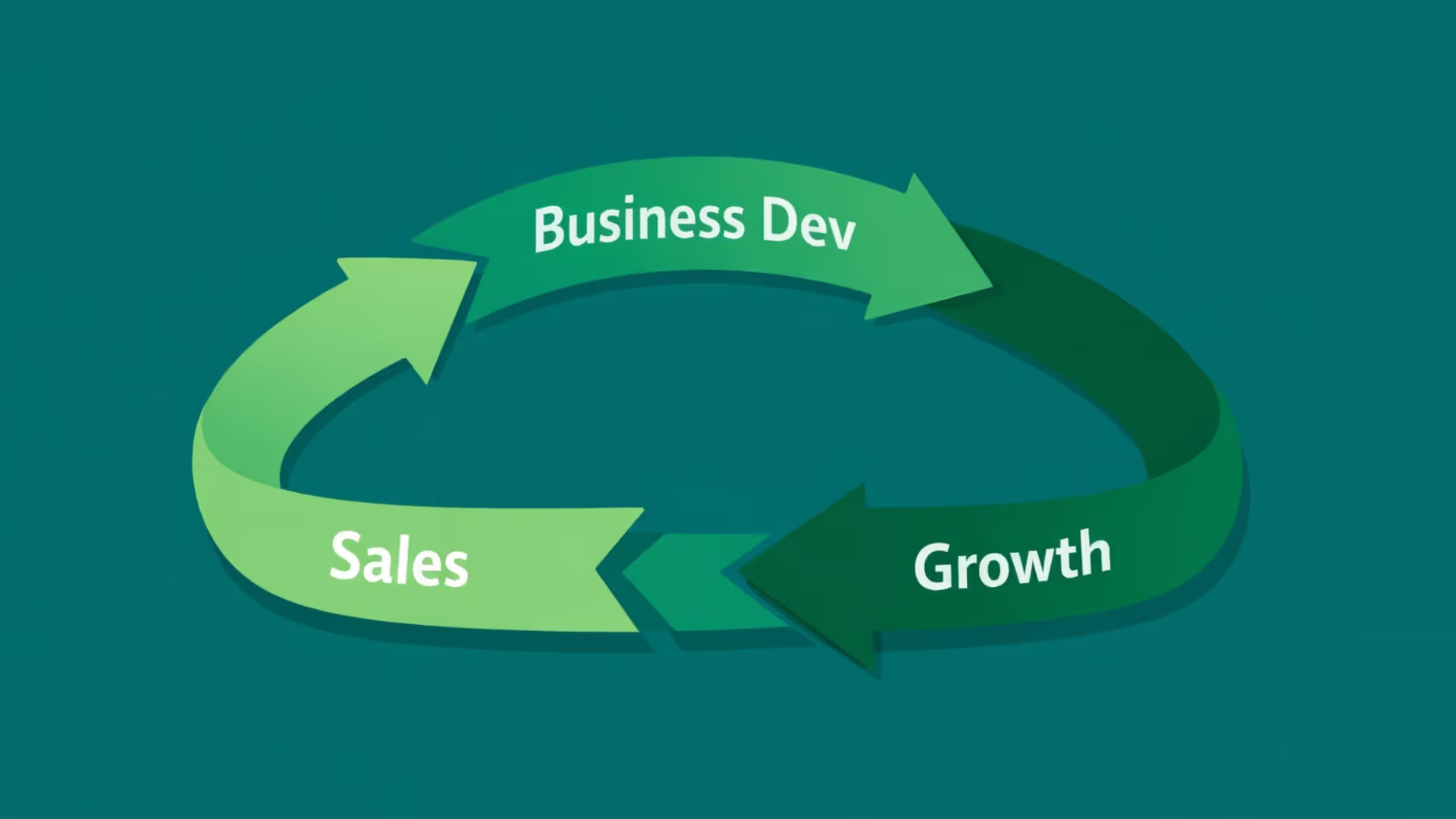


While sales and business development strive for the same end goal, that is, revenue generation, they have different approaches to achieve it. Let's understand this in detail.
At a glance:
Sales = Conversion
Business Development = Opportunity creation
Sales = Short-term revenue
Business Development = Long-term growth
Sales = Execution
Business Development = Strategy
Sales and business development: clarifying the roles
Sales focuses on grabbing opportunities that have potential to yield immediate income by converting qualified leads into paying customers and working with existing demand. They engage directly with prospects and clients, guide them through the sales process and close deals.
Business development, on the other hand, works toward a long-term vision by identifying markets, discovering potential partners, and client acquisition. They might negotiate alliances, explore emerging segments, or pilot new business models.
Here’s a short table listing the differences between sales and business development.
Why integrating sales, business development and technology is important
Let’s look at it from a problem -> solution -> outcome perspective.
Problem
Misaligned sales and business development teams create costly revenue gaps. If BD generates a lead, and the handoff to sales is not clear, those prospects fall through the cracks. If sales department is not kept in loop about BDs partnerships, there’s a chance they might overlook lucrative sales channels.
For example, one department might pitch a prospect who was already engaged by the other, causing customer confusion.
Industry research also confirms that fragmented processes undermine growth. Bain & Company conducted a survey of over 1200 companies across 18 industries and found that 70% of the organizations fail to integrate their sales process into their CRM. This results in only 20% of the lot who fully understand the value of integrating opportunities with technology. The rest are honestly just missing out on revenue on the table.
Solution
- When sales and business development come together, internal communications are better, and the sales processes are also carried out more efficiently.
- Both teams can share with each other customer insights, reducing wasted effort. When goals unify, all team members pull in the same direction.
- More qualified leads fall into the pipeline, which translates into higher conversion rates, which again means increased revenue generation.
- Since incoming leads are vetted to be sales qualified, sales cycles are shorter compared to those who have just shown “interest” and chasing dead-end signals.
In fact, Bain & Company also highlights that companies that “harmonize their strategic sales play approach” with technology and cross-team collaboration are “best positioned for accelerated revenue growth”
Outcome:
- Combined efforts capture more business and wider market coverage. When BD strategically builds a pipeline and the sales execute by converting quickly, your company will see higher win rates and faster deal cycles.
- Aligning sales and BD smooth the customer journey as well. From contact to negotiation to renewal, the customer sees one cohesive team rather than disjointed handoffs. Internally, this leads to higher conversion rates with a better upsell/cross sale opportunity.
- Combining efforts means less overhead costs. Shared intelligence can significantly reduce redundant research. Integrating technology into your system, like use of CRM, and automation systems helps speed the process and save time for more valuable activities like closing deals.
Key strategies for integration of sales and business development
Share a unified CRM and track leads together
A CRM can be a life saver for both sales and business development. Shared CRM access gives both teams visibility into the customer journey. This enables teams to identify bottlenecks, prioritize high-potential accounts, and align decision-making.
For example, when BD records a referral or partnership opportunity, the sales team should be able to see the relevant context when following up. This can include the source of the opportunity, previous conversations, the prospect's needs, the stakeholders involved and the agreed next step.
A CRM does not automatically eliminate miscommunication, but maintaining a shared record can make it easier for both teams to understand what has happened and what needs to happen next.
Set joint goals, like increasing deal size or market penetration
Joint goals for both teams can look like targeting to increase qualified leads by X%, a jump in deal size, and exploring new markets that fit the company’s ICP.
This is great for accountability and prevents blame game for e.g. BD blaming sales for not closing, and sales team blaming BD for weak leads.
Meet regularly to discuss lead quality and conversion
Regular reviews give sales and BD a chance to discuss lead quality, stalled opportunities, partner performance and feedback from recent deals. The frequency can depend on the volume of opportunities and the length of the sales cycle. The goal is to identify what needs to change, rather than hold meetings simply to exchange status updates.

Understand where BD ends and sales begins - and collaborate in the overlap
If you run a business, make sure to standardize a handoff protocol of qualified leads. This includes clear criteria (e.g. lead scoring thresholds), documentation of all prior interactions, and timely notifications to the sales team.
Set up a formal Service Level Agreement (SLA) between BD and sales which can help establish what is “sales-ready”. This way, valuable prospects won’t get lost.
A practical handoff process should answer four questions:
1. What makes an opportunity ready for sales? Define the information or qualification criteria required before responsibility is transferred.
2. Who owns the next action? Assign responsibility so that neither team assumes the other will follow up.
3. What context must be shared? Record the source, previous conversations, buyer requirements and other details needed to continue the discussion.
4. How will the outcome be communicated? Sales should share feedback on opportunity quality and progression so BD can improve the way it identifies and develops opportunities.
A shared CRM, clear ownership rules and an agreed handoff process can help both teams follow these steps consistently.
Focus on automation and AI
Automation and AI can support the coordination between sales and business development, provided the underlying process is clear. For example:
- Prioritising opportunities: AI-assisted scoring can help teams decide which records to review first, but scores should be checked against qualification criteria and actual outcomes.
- Managing routine tasks: Workflow automation can support reminders, task assignment and follow-up scheduling, reducing the chance that an agreed next step is overlooked.
- Summarising interactions: AI can help organise notes from previous conversations so the receiving team has useful context before contacting a prospect.
- Spotting patterns: Teams can review trends in opportunity sources, conversion and stalled deals to identify which channels may deserve further attention.
According to Mckinsey, AI can automate 70% of that work, giving reps more time to do what actually matters: selling.
When should a business focus more on sales vs. business development?
The right focus depends on where your growth process is getting stuck. More activity from one team will not necessarily fix a problem that belongs to the other.
Consider prioritizing sales when:
- You already have a reasonable flow of qualified opportunities, but too few progress from discovery to proposal or deal closure.
- Deals frequently stall during negotiation, pricing discussions or internal buyer approvals.
- Your sales team needs to improve qualification, follow-up, forecasting or conversion.
Consider prioritizing business development when:
- Your business relies heavily on a narrow set of acquisition channels and needs to develop new ones.
- You see opportunities to reach new customer segments through partnerships, referrals or channel relationships.
- You need to explore a new market or commercial relationship before it can become a repeatable source of opportunities.
If the main problem is a lack of potential customers, first identify whether the gap is in marketing, lead generation, sales development or business development. These functions can work together, but they are not interchangeable.
Role of sales and business development
The choice between sales and business development also depends on the work you enjoy. Sales often involves direct customer conversations, negotiation and moving opportunities toward a decision. Business development may involve more market exploration, partnership development and building opportunities whose results take longer to materialise. Neither role is inherently more strategic or more senior; the responsibilities depend on the organisation and the position.
Conclusion
To conclude, if you are still treating your sales and business development as separate, your strategy is outdated and needs some revamping. Conduct cross-departmental workshops, unify CRMs and any measure you think will help both work together. Start now to see results in 3-6 months!